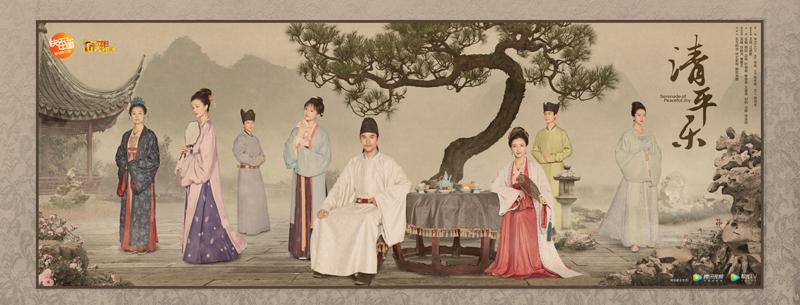
When The Longest Day In Chang’an was popular, the flower buds of women in the Tang Dynasty were impressive. Qingpingle, which followed closely, was also regarded as a highly restored history because it presented the makeup of Pearl in the Song Dynasty.
The development of makeup research in recent years is behind the film and television drama’s efforts to restore the face of ancient life from a large number of "shocking people" in the past. Chen Shiyu, the service director of film and television dramas such as Qingpingle, is a scholar of costume history and arts and crafts. He studied under Mr. Sun Ji in Beijing Institute of Fashion Technology and is also a consultant on the history and service of CCTV’s National Treasure program. Li Ya, a professor in the Department of Stage Art of Shanghai Theatre Academy, has also written works such as History of Ancient Jewelry in China, Streaming Earrings: Earrings in China in Past Dynasties, and Formula of Ancient Makeup in China.
The Beauty of China’s Makeup is a book co-written by Li Ya and Chen Shiyu, which not only presents a complete picture of China’s makeup from the Zhou Dynasty to the Qing Dynasty, but also outlines the social ideological style and aesthetic changes behind it. "The power of power, the restraint of morality, the different tastes of elite culture and market culture have all left a deep mark on women’s makeup in different times." Zhu Liangzhi, a professor of philosophy at Peking University, pointed out in the preface.
"After studying makeup for thousands of years, it is found that human nature is unchanged in ancient and modern times. Pursuing beauty and fashion trends is the commonality of people in all ages, but the forms of expression are different, and some times will be more obvious and more tolerant." Li Ya said.
What is "fish flattery"?
"Makeup as a research topic is very rare." Since studying for a master’s degree in 1999, Li Ya has been deeply involved in the field of cosmetic culture research. At first, I chose to study this direction simply because few people paid attention to it. In 1981, after the publication of Shen Congwen’s "Research on Ancient Chinese Costume", ancient costume became a research hotspot, but few people paid attention to the makeup that appeared in ancient murals and poems together with costume.
After Li Ya really entered the field of decoration research, she found it very difficult. First of all, there are no first-hand cultural relics, and makeup must be attached to the human body, and once the human body rots, makeup will be gone. Therefore, compared with other material and cultural studies, makeup lacks first-hand material information and can only be studied through other channels. Auxiliary research approaches include literature scattered in history books, note novels, poems and songs, as well as image research including ancient figure painting and figure sculpture.
However, whether recorded in words or portraits, either "only know its name but not its shape" or "only know its shape but not its name". In addition, after thousands of years of polishing, many important information has faded, peeled off or lost. As a researcher, we need to collect all the information, and then find a reasonable correspondence between "shape" and "name" in order to restore the historical face of makeup to the greatest extent.
Li Ya and Chen Shiyu have restored a popular makeup "Fish Mei Zi" that appeared in the Song Dynasty. There is only a brief record of this kind of makeup in the History of Song Dynasty, but at first they were completely confused about what it meant to be "a bone in the gills". Later, when I was studying the female crown in the Song Dynasty, I happened to find that there was a kind of "Zhuguan" at that time, which was made of a hard fish stone taken out from the head of herring. After polishing, polishing and oil immersion, it became a translucent gem like agate, which was used as a crown decoration. Only then did they understand that the so-called "Fish Mei Zi" was made by sticking this gem on black paper, thus solving this "small historical puzzle".
The Beauty of China’s Makeup also shows 29 sets of restoration pictures of real makeup. When the ancient makeup appeared on modern people’s faces, the historical gap was broken. In recent two or three years, Li Ya has devoted a lot of energy to the restoration of ancient makeup after her research. She said that it was a practice after she completed the correspondence between "shape" and "name". "This is an uncontrollable desire, and I really want to know what these ancient portraits and sculptures are like when they are restored by real people."
However, the transformation from abstract words to concrete images requires secondary creation, which inevitably has subjective elements. Every scholar will do something based on his own research, which is also a great test for their textual research ability and aesthetic grasp ability. "It is necessary to ensure that the restored ancient makeup conforms to the temperament of that era at first glance."
Women’s status behind makeup
For ancient make-up, a sentence in the Warring States Policy is very classic, "A scholar dies for a confidant, and a woman looks for herself." In fact, Li Ya found that ancient women’s makeup was not as simple as women pleasing people.
The Han Dynasty was the formative period of the ancient aesthetic standards of makeup, and from then on, it laid the characteristics of elegance. At the same time, Confucianism also established the absolute dependence of women on men, and put forward the theory of "three cardinal guides and five permanents" and "respecting yang and belittling yin". Especially the Women’s Commandments written by Ban Zhao in the Eastern Han Dynasty emphasized women’s submission, inferiority and obedience, and "standardized" women in China for more than two thousand years. These thoughts of the times have influenced women’s makeup. Since the Han Dynasty, the makeup style has gradually become humble and feminine, and even some morbid makeup has begun to appear.
Sun Shou was the wife of Liang Ji, a consort and powerful minister in the Eastern Han Dynasty. The Book of the Later Han Dynasty recorded that she was "beautiful in color and good in appearance" and liked to "frown and make up". The so-called "frown" is similar to a figure-of-eight eyebrow, which hangs down, and "crow makeup" means that there seem to be two tears hanging under the eyes. Sun Shou walks "hunched", that is, hunched over, looking ill, and laughing is a "decayed tooth smile" with bulging cheeks like toothache. History books say that this kind of makeup is "charming", but it once became the most popular fashion makeup in Beijing. "’Women are weak and beautiful’ is the most important point in Women’s Commandments, which emphasizes that women should show weakness, not only because they are soft and docile inside, but also because they are weak and weak in appearance, which is why morbid makeup is popular." Li Ya explained.
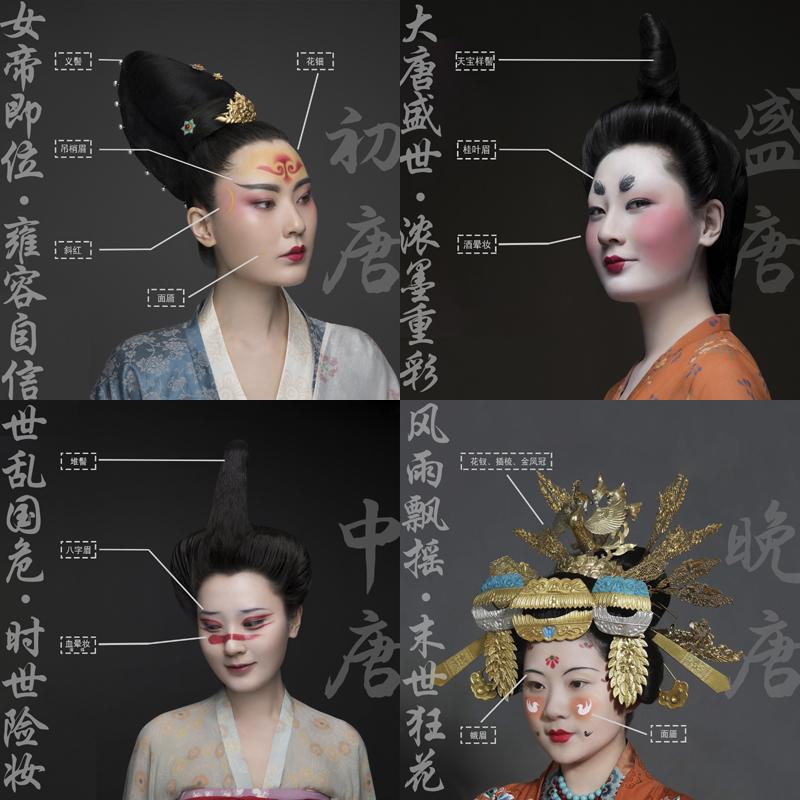
However, when the status of women in the whole society begins to rise, traditional aesthetics will also be broken. The makeup in the Tang Dynasty is the most complicated and gorgeous in history, and the makeup carrier is also very rich. Especially during the reign of Wu Zetian, the gorgeous makeup reached its peak. A number of painted figurines of the Tang Dynasty in the era of Wu Zetian were unearthed in Astana, Xinjiang. The face of the buried female figurines was swept by thick eyebrows, and the area of rouge blush was extended from under the eyebrows to the side of the face. In addition to the simple fan-shaped shape, the flower-shaped shape on the forehead was also smudged with complex patterns such as flowers, rolling grass and cirrus clouds. The oblique red on both sides of the cheek is not a simple blush, but a complex pattern. Ordinary maids in remote areas are all like this, which shows how charming the makeup of upper-class women in Chang’ an and Luoyang was at that time.
After Wu Zetian abdicated, Princess Taiping and Empress Wei were still active in the power center, and the gorgeous makeup style of Wu Zhou continued until the early years of Emperor Xuanzong’s succession. After the appearance of Yang Guifei, the popular fashion in the Tang Dynasty changed into plump beauty, loose clothes and big red makeup, and finally became an impressive symbol of "prosperous Tang Dynasty". "So the development of makeup is inextricably linked with the strength and self-confidence of women."
Makeup and troubled times
From the makeup, we can also see some changes in social thought. At the end of the Eastern Han Dynasty, the Great Plague, coupled with years of war, caused a large number of deaths. In the Northern and Southern Dynasties, the idea of "reincarnation, karma" spread with Buddhism, and Buddhism was also designated as the state religion in the Northern Wei and Southern Liang Dynasties. In addition to literature, music, sculpture and other fields, Buddhism also influenced the makeup at that time, and yellow eyebrow ink makeup began to appear. When Princess Shouyang of Emperor Wu of the Southern Song Dynasty got married, she painted "eight-character palace eyebrows holding yellow forehead", that is, the eyebrows were eight-character, and yellow makeup powder was painted on her forehead, which was called "yellow forehead". This is because the Buddha is the face of the golden Buddha. With the spread of Buddhism to the east, all kinds of forehead yellow, flower yellow and Buddha makeup began to be popular, all of which were painted yellow on women’s faces.
After the Anshi Rebellion, the Tang Dynasty went into decline. In the mid-Tang dynasty, there was a trend of pursuing weird and grotesque makeup, and Bai Juyi also wrote a special poem "Contemporary Makeup". According to the poem, it was popular for women to draw eight-character eyebrows at that time, and their lips were painted black without lipstick, and their faces were painted with ochre powder instead of vermilion and rouge. The makeup with ochre powder on the face is a kind of makeup from Xizang, which came with the Tibetan army invading Chang ‘an twice after the Anshi Rebellion. The ultraviolet radiation on the Qinghai-Tibet Plateau is very severe, and it is easy for local people to get high original red on their faces, so they will use yak milk to refine a brown whey and apply it to their faces as a mask, which has formed an ochre makeup effect and has been popular in Chang ‘an. Bai Juyi believes that this "dark face" makeup does not conform to the traditional makeup aesthetics of the Han nationality, and it looks "like a sad cry" and is a "phase of troubled times".
"The general trend of the world, the peak will decline, and the full moon will lose. All history can’t escape this trend, and the history of makeup is no exception. After the explosive development in the Wei and Jin Dynasties, and then to the peak of the Tang Dynasty, and finally to the late Tang Dynasty, it was already in a state of profusion and extravagance. In the Song Dynasty, makeup suddenly took a 180-degree turn, from rich and colorful to simple and simple. Moreover, after the Song, Yuan, Ming and Qing Dynasties, little has changed. " Chen Shiyu wrote in China’s Beauty of Makeup.
Reporting/feedback