"I hope that young people in Hong Kong will visit and exchange more in the Mainland and have a deeper understanding of the country."
Chen Zhuoxi, member of the Chinese People’s Political Consultative Conference and president of Hong Kong Professional Continuing Education School (hereinafter referred to as "Hong Kong College"), told The Paper (www.thepaper.cn).
Chen Zhuoxi graduated from the Chinese University of Hong Kong and worked in tvbi. Later, he joined the education sector as the principal of the Hong Kong College.
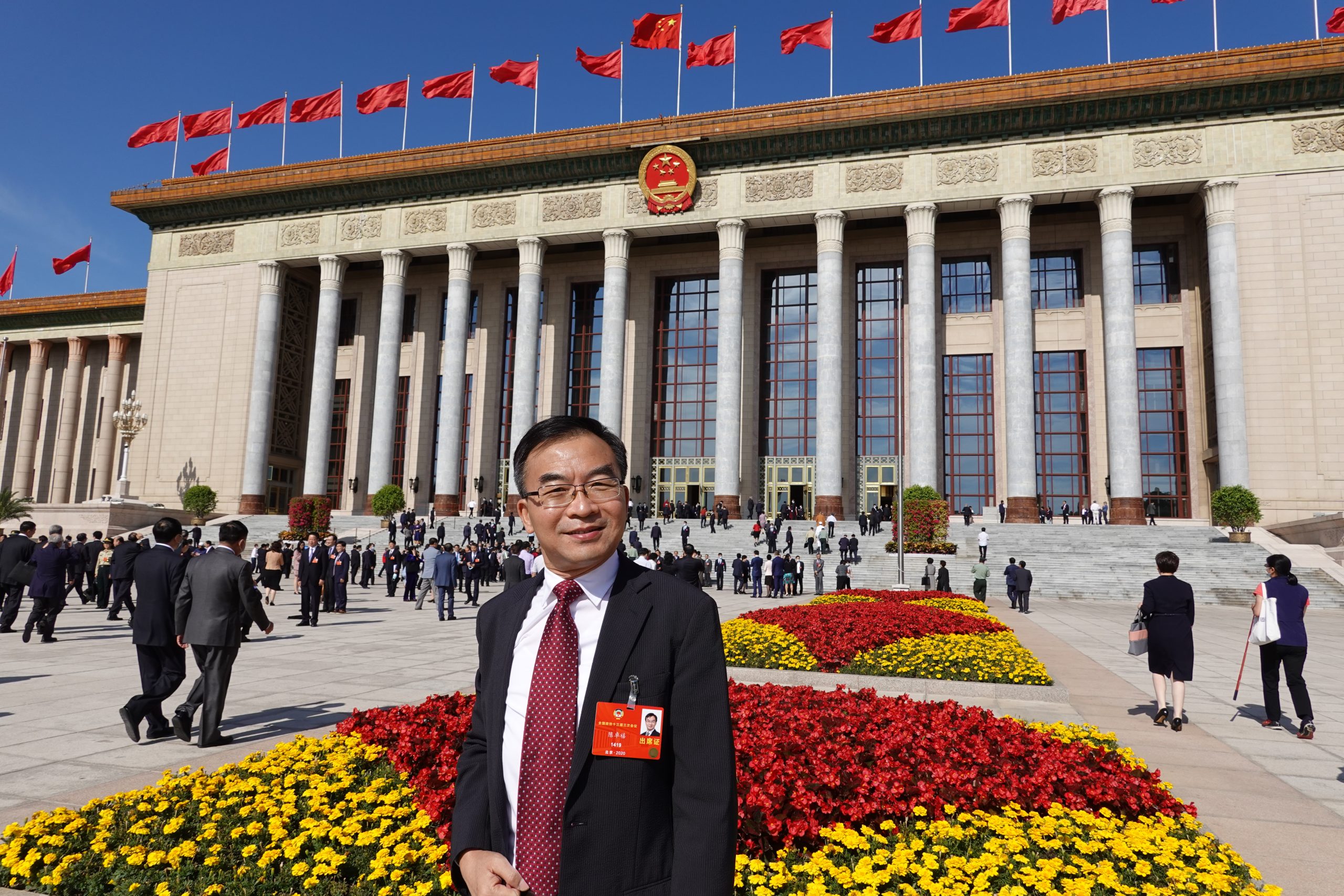
Chen Zhuoxi, member of Chinese People’s Political Consultative Conference Port Area.
At the end of 2017, Hong Kong College held a graduation ceremony, and two graduates were asked to leave the scene because they failed to abide by the school rule of "Standing when playing the national anthem". As the principal, Chen Zhuoxi had an open dialogue with the students who came to the scene outside. He told the students: "As a patriotic school that loves Hong Kong, Hong Kong College must hold high the patriotic flag. There is no room for compromise, even in colonial times. If you don’t even know this, you have chosen the wrong school. "
His speech with such a clear stand sparked heated discussion, so he was also called "patriotic president" and "president who protects the national anthem".
On January 24, 2018, he was elected as a member of the 13th National Committee of Chinese People’s Political Consultative Conference. As an educator in Hong Kong, Chen Zhuoxi hopes that young people in Hong Kong can seize the opportunity and determine their future development direction.
Recently, The Paper interviewed Chen Zhuoxi and asked him to talk about the present and future of education in Hong Kong.
Putting national education into the assessment of further education in Hong Kong
The Paper: What are your main proposals for the National People’s Congress this year?
Chen Zhuoxi:I have a proposal on the theme of getting rid of poverty through education, and developing national education for young people in Hong Kong. Many young people in Hong Kong like to go abroad for a "Working Holiday". I think we can use similar methods to get young people in Hong Kong to participate in education in the Mainland to get rid of poverty. China has reached the last year of poverty alleviation this year, but it is still necessary to prevent it from returning to poverty. Although absolute poverty will be solved, there is still a problem of relative poverty in social development. How to solve the problem of relative poverty through education may be a good direction.
The Paper: How to involve Hong Kong youth?
Chen Zhuoxi:We want some interested young people from Hong Kong to take part in relevant work in the Mainland, even for half a year or a year. In addition, some primary and secondary schools in Hong Kong have already twinned with the mainland. If the twinning of sister schools is transferred to poor areas, teachers, students and parents of primary and secondary schools in Hong Kong will be organized to help primary and secondary schools in poor areas in the mainland in whatever way they can, and parents of Hong Kong students will be organized to visit and exchange in the mainland. In addition, sister schools in Hong Kong and the Mainland can also work together to get rid of poverty through education, so that everyone can participate in education to get rid of poverty.
The Paper: In your opinion, is this year’s NPC and CPPCC different from the past?
Chen Zhuoxi:The biggest difference this time is the epidemic situation. I think everyone really feels the whole process of epidemic prevention management. We have made great achievements in epidemic prevention, but the epidemic situation still affects the arrangement of the two national conferences this year, and each meeting is not long. In addition, as a member of Chinese People’s Political Consultative Conference Port Area, I feel that there is another difference: the Hong Kong issue has become a very important topic for the two sessions of the National People’s Congress. This will have a great impact on Sino-US relations, the world situation and the local situation in Hong Kong. We should also make psychological preparations and work preparations to cope with changes in the external environment.
The Paper: As an educator, do you think there is a problem with national identity education in Hong Kong?
Chen Zhuoxi:Education in Hong Kong is divided into two kinds of education: narrow sense and broad sense. Education in a narrow sense mainly refers to the education system in Hong Kong, while education in a broad sense refers to the growth environment of young people in Hong Kong. At present, the growth environment of young people in Hong Kong is not good. Their information and thinking are controlled by rumors and fake news of social media, ethnic groups are torn apart, and hatred is antagonistic, which is not conducive to the healthy growth of young people in Hong Kong.
The Paper: How do you think this situation should be changed?
Chen Zhuoxi:There are many problems in education, and a general plan is needed. I think Hong Kong may have to carry out education reform. For example, courses such as China history and national education should be changed in the curriculum of Hong Kong students. Not only that, but also the requirements of college students should be adjusted to achieve interlocking. After all, entrance examination is a baton, and only examination can effectively implement and influence the curriculum arrangement. If the entrance examination system does not change, the overall change will not be easy.
The Paper: How can we make such an education system effective?
Chen Zhuoxi:Hong Kong’s education management departments should play a role, especially in management. It is very important that both primary and secondary schools and universities should act against abnormal violations. I believe that with the changes in the general environment and the implementation of these tasks, the situation in Hong Kong should change, but it cannot be completely changed for a while.
Young people in Hong Kong are still more concerned about further studies and employment.
The Paper: What do you think of young people in Hong Kong?
Chen Zhuoxi:Although there was a storm of amending laws in Hong Kong last year, I think that, on the whole, the vast majority of young people in Hong Kong are not the situation presented by the media. Most of them are not interested in politics, but are more concerned about future issues such as further studies and employment, including their own immediate interests. At present, their attention and attitude are only affected by the environment in stages. After all, the social situation has had a great impact on them. As long as the situation cools down, I believe they will gradually return to their own future, further studies and employment.
The Paper: Hong Kong College is a private school with clear patriotic views. Is it difficult to survive in the current environment of Hong Kong?
Chen Zhuoxi:Our school’s popularity and influence in Hong Kong society is still relatively small, including some teachers. Because of their different political positions, they do not recommend or even oppose students to study in Hong Kong, which makes our enrollment more difficult. We are the only private patriotic university in Hong Kong, which was suppressed before the reunification. Therefore, we are congenitally deficient and cannot be compared with public schools in terms of equipment and school conditions.
The Paper: Has the situation improved in the past two years?
Chen Zhuoxi:Because the situation of congenital deficiency before the reunification has not been well reversed, and the education authorities in Hong Kong adopt the theory of market competition for private schools, usually the government will give you more support if you do very well, so the distance between us and public schools is getting wider and wider.
The Paper: How does your school establish a normal teaching order?
Chen Zhuoxi:At present, students are taking classes online at home, so the school situation is still very calm. Last year, when there was a storm of amending laws, although some students took to the streets, there were very few students, which had no impact on the overall situation of our school. We also made rules with teachers. We hope that teachers and other colleagues and staff will take students’ fundamental interests and care for them, and will not encourage students to commit any illegal acts, let alone take part in dangerous actions, including if students want to hold activities and put up slogans in the school, and we will also guide them to express their opinions within the framework of certain rules and systems. As a school, it is natural for students to have different positions and views on things, but we still hope that they have a certain order.
The Paper: How do you usually guide them?
Chen Zhuoxi:I hope students can’t just say simple slogans, but speak their positions accurately. I also organized some students to meet with me, encouraging them to master the ins and outs of the problem and learn to think independently, so as to put forward a level of opinion. Although they haven’t fully accepted my opinion, and even some students with different positions find it hard to accept it for a while, I think it is necessary to have a dialogue to let everyone know each other’s positions.
The Paper: Do you have any other ways to improve students’ communication and understanding of the Mainland?
Chen Zhuoxi:We attach great importance to students’ deep understanding of the mainland, and often organize students to exchange internships in the mainland, not only for visits, but also for in-depth communication, especially for making friends. This is a sustained and long-term relationship, which requires two-way communication. Our students visit a school in the mainland, and teachers and students from this mainland school will also come to Hong Kong for exchanges, including students from both places visiting each other’s families and eating. This is a deep interpersonal communication. We are designing a business start-up plan for Greater Bay Area, so that students can participate in internships and start-ups in the Mainland, and face young people in Hong Kong in the form of rehabilitation, so that they can go from perceptual knowledge to careful experience, and finally rise to theoretical knowledge. In any case, we hope to explore more experiences and models and finally promote them in Hong Kong.